
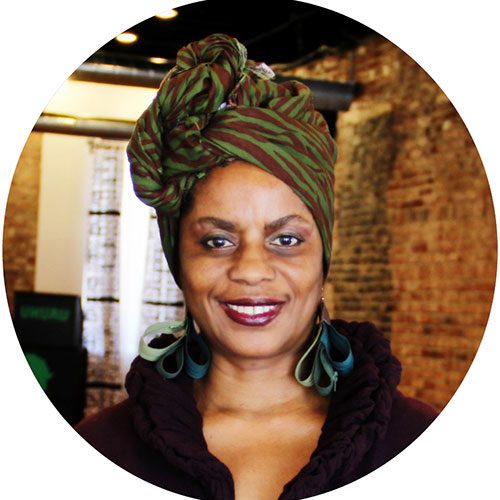
INTERVIEW TRANSCRIPT – OUR WORLD AS WE SEE IT ON KPFA
Listen to the interview at http://tinyurl.com/lovethroughreparations
Deputy Chair Ona Zené Yeshitela on solidarity, ownership and the Reparations Investment Company
Welcome to Our World As We See It, a weekly show produced by students and staff from Oakland School for the Arts. In this conversation, hosts Wendy Snyder and Cara Locke speak with Ona Zené Yeshitela, Deputy Chair of the African People’s Socialist Party (APSP) and president of the African People’s Education and Defense Fund.
Cara leads the Reparations Investment Company (RIC) Donor and Investment Committee. Wendy and Cara are both members of the Uhuru Solidarity Movement, organizing white people toward reparations under Black working class leadership and towards African self- determination, which is to the benefit of all humanity and life.
Ona Zené is the architect of the Black Power Blueprint and its newest initiative, the Reparations Investment Company: an anti- gentrification program to transform North St. Louis through renovation, economic development and political power by and for the Black community.
From the Uhuru Black Gym to the Party
WENDY SNYDER: Could you describe your background and how you came to be the Deputy Chair of the African People’s Socialist Party?
ONA ZENÉ YESHITELA: First, I want to salute my leadership, Chairman Omali Yeshitela, who has led the Uhuru movement and the African People’s Socialist Party since 1972, and has worked tirelessly to liberate Africa and African people.
I met the movement in 1993, when my brother took me to the Uhuru Black Gym of Our Own in St. Petersburg, Florida. Speaking with the organizers who worked in the gym, my understanding of the movement really deepened. In 1994 I joined the International People’s Democratic Uhuru Movement as a member, and later became its international treasurer, helping create economic development projects with skills from my colonial job, many years in human resources for the city.
It took a long time for me to join the Party, about 15 years, but my commitment deepened. One day I drove to work, sat in the parking lot, and decided I would resign from my colonial job. From that day on, I joined the African People’s Socialist Party.
Why St. Louis?
CARA LOCKE: How did the Black Power Blueprint come about, and why did you come to St. Louis?
ONA ZENÉ YESHITELA: The Party first came to St. Louis after the murder of Mike Brown in 2014. They sent me in at the end of 2016, and again in 2017, to spend one week locating a community center, a bakery café and a solidarity center. After seeing the conditions facing the African community on the north side, I called the Chairman and told him that if I left, I wouldn’t be able to come back for three to five years. He agreed that I should stay with those objectives.
St. Louis was affordable, and it is surrounded by eight states, which has proven to be the correct strategy. It is now our national headquarters.
The Black Power Blueprint developed organically. We attended neighborhood association meetings, met with other organizations, and got working-class people in the neighborhood to know one another. We find out where the people are and what they need, and we start putting boots on the ground and making it happen.
Getting Off the Treadmill
CARA LOCKE: Chairman Yeshitela describes investing in the Reparations Investment Company as “a greater investment in a future where African people have self-government and power over our own resources, land, lives and destinies.” Could you say more about what that looks like?
ONA ZENÉ YESHITELA: When I joined the movement, I learned a phrase that stayed with me for decades: getting off the treadmill. We have organized fundraisers, marches, flea markets, webinars and campaigns to sustain our work. That work was necessary, but fundraising alone became a treadmill. Every month we ran hard just to survive; the money comes in, the bills get paid, and we start over at zero.
Genuine economic development is very different. It means institutions that continue to produce value for African people long after the fundraiser ends: land, businesses, housing, food production, media, industry, schools. We want it back, in the hands of the African community. Fundraising buys the fruit for the day, but economic development buys the farm that feeds for generations.
Freedom Farm
Take Freedom Farm, which we are constructing right now. We started with nine vegetable boxes and three and a half barrels of herbs, and now we have 24 rows of 25-foot beds on the north side of St. Louis. The long-term goal is to reduce dependency on endless fundraising by building income- generating African institutions that strengthen economic sovereignty and self- determination.
Ownership as Defense
As African communities face displacement and gentrification, when African people own bakeries, cafés, houses, farms, schools and media, we create an anchor that protects our community from removal. Ownership becomes a defense. We want to develop without displacement, with ownership. Every African-owned institution we build becomes part of a reparative economy where dollars circulate in our community, we create employment, train young people, preserve our culture and strengthen our political power.
Solidarity, Not Charity
WENDY SNYDER: There’s no reason people should not get involved in this on some level. We’re in Oakland, in the Bay Area, and we’re winning investors and supporters.
ONA ZENÉ YESHITELA: This is real solidarity, not charity. We’re looking for something that can empower the people to take control over their own lives. People in this community want to be self-sustaining and stand proud, able to do for themselves. We’re not calling on people’s charity; we’re calling for genuine solidarity.
When Love Becomes Revolution
WENDY SNYDER: At the Party’s plenary in April, you led a panel on love. The Burning Spear reported that to fight for revolution while fighting for love, those fights are one and the same. How are the fight for love and the fight for revolution, reparations and solidarity one and the same?
ONA ZENÉ YESHITELA: It has been four months since the plenary, but this question of love and revolution comes up a lot. We want to do a series on love, from love to revolution.
Let me start with Che Guevara: “Let me say, at the risk of seeming ridiculous, that the true revolutionary is guided by a great feeling of love.” I unite with that. Only love of the people could allow me to join the ranks of Africans who have fought for freedom and oppose the most powerful oppressor in the history of the world. My love for the people is given material form in my participation in the revolutionary struggle.
Our theory of African internationalism teaches us that the colonial system is parasitic; it can only live by sucking the lives and resources of colonized and oppressed African people. For us, the fight for revolution and the fight for reparations are the same.
It is different from romantic love, the fantasy of the house and the white picket fence. It is embracing our humanity. Once you see the suffering imposed by colonialism and know it can be changed because it is structural, you become a changed person. In the Uhuru movement we say that once you go about changing the world, you change yourself.
Science and history teach us that the attack on Africa 600 years ago began the slave trade, the new mode of production that ties the whole world together in this parasitic relationship. This is why we say white people everywhere owe reparations.
The Counteroffensive
CARA LOCKE: It’s not just romantic love; it’s a tough, fierce kind of love for African liberation, for the African working class and for all colonized people. At the end of this month of July it will be four years since the FBI raided seven homes and offices of the Uhuru movement, including your home, targeting Chairman Yeshitela and you. How do these attacks affect this fight for the revolutionary process?
ONA ZENÉ YESHITELA: Four years already. The thing is, you never forget. To this day I still sleep with my clothes on, because they attacked us at five o’clock in the morning Central Time. I was preparing to hold a seminar with 14 African women to become certified as doulas, and the Chairman was preparing to go to the gym like he always does.
The FBI targeted the movement because Chairman Yeshitela and our party identified colonialism, not racism, as the main contradiction. Since the early 1970s the Party has opposed colonial wars as unjust wars: Vietnam, Nicaragua, El Salvador, Cuba, Palestine, and most recently Ukraine and Iran. The white community can build a principled relationship with colonized people by opposing colonialism and colonial violence.
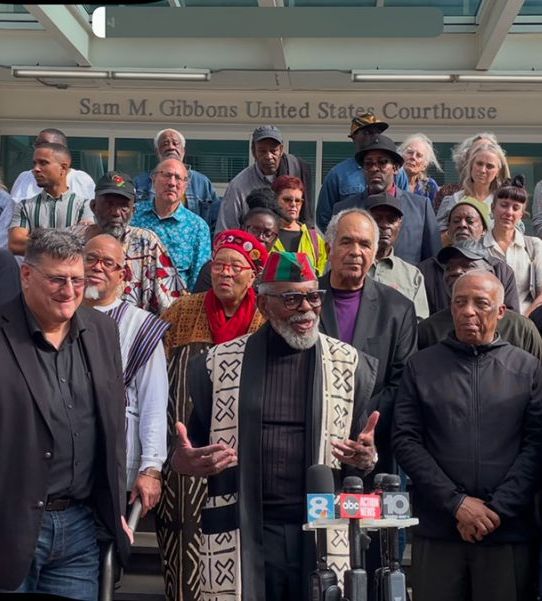
EDITOR’S NOTE: Go to handsoffuhuru.org to learn about the four year counteroffensive including the trial of the Uhuru 3 where the government lied and lost and the movement told the truth and won!
Pictured: Uhuru 3, Attorneys and supporters December 2024 – Tampa, FL at the press conference on the steps of federal courthouse in Tampa, Florida following the victory in the sentencing hearing on December 16th.
Joining the Struggle
WENDY SNYDER: Our commitment to solidarity and reparations involves a degree of sacrifice, which we do out of love. Would you like to add anything about talking to white people about joining this movement?
ONA ZENÉ YESHITELA: First, Wendy and Cara, I appreciate you so much. For me there is nothing more motivating than knowing you are building a new future, one that is not based on a parasitic relationship of oppressed and oppressor.
We have always believed that real power in the struggle for reparations is the participation of a politically conscious population. First, the colonized African population had to be brought to consciousness of the righteousness of the reparations demand. Then the white colonizer population had to be given an opportunity to break with the colonial ruling class and join the freedom struggle of African people. The Reparations Investment Company is the latest, most powerful and creative way we have created for white people and others to join our struggle and negate the population removal called gentrification.
Building the Reparations Investment Company
We’re going to have spinoff businesses within the company: Reparations Realtors, who will find people in the community who can purchase properties and teach them how to buy and get funding; an Uhuru staging company, to stage each house we buy; and Uhuru 314 Lawn Care, employing youth and teaching them to be entrepreneurs through ownership of their own companies. The Reparations Investment Company is critical to the future.
How to Get Involved
WENDY SNYDER: How can people get in touch with you, donate or invest in the project?
ONA ZENÉ YESHITELA: You can contact us at blackpowerblueprint.org or call 314-380-8016. For the Reparations Investment Company, go to reparationinvestment.com or call 314-328-4816.
To find out how to donate, invest and/or participate with us in organizing for reparations, contact info@uhurusolidarity.org